

8-10 mins read

Introduction
When constructing a house, most people focus on cement, bricks and finishing materials. However, the quality of reinforcement steel is equally important for structural safety and durability.
In this article
- What are TMT bars?
- Understanding TMT grades
- Problems with substandard steel
- IIT Madras research findings
- Price comparison
- Long-term structural impact
- How to identify genuine steel
- Other factors affecting RCC structures
- Recommendations for homeowners
- Conclusion
1. What Are TMT Bars?
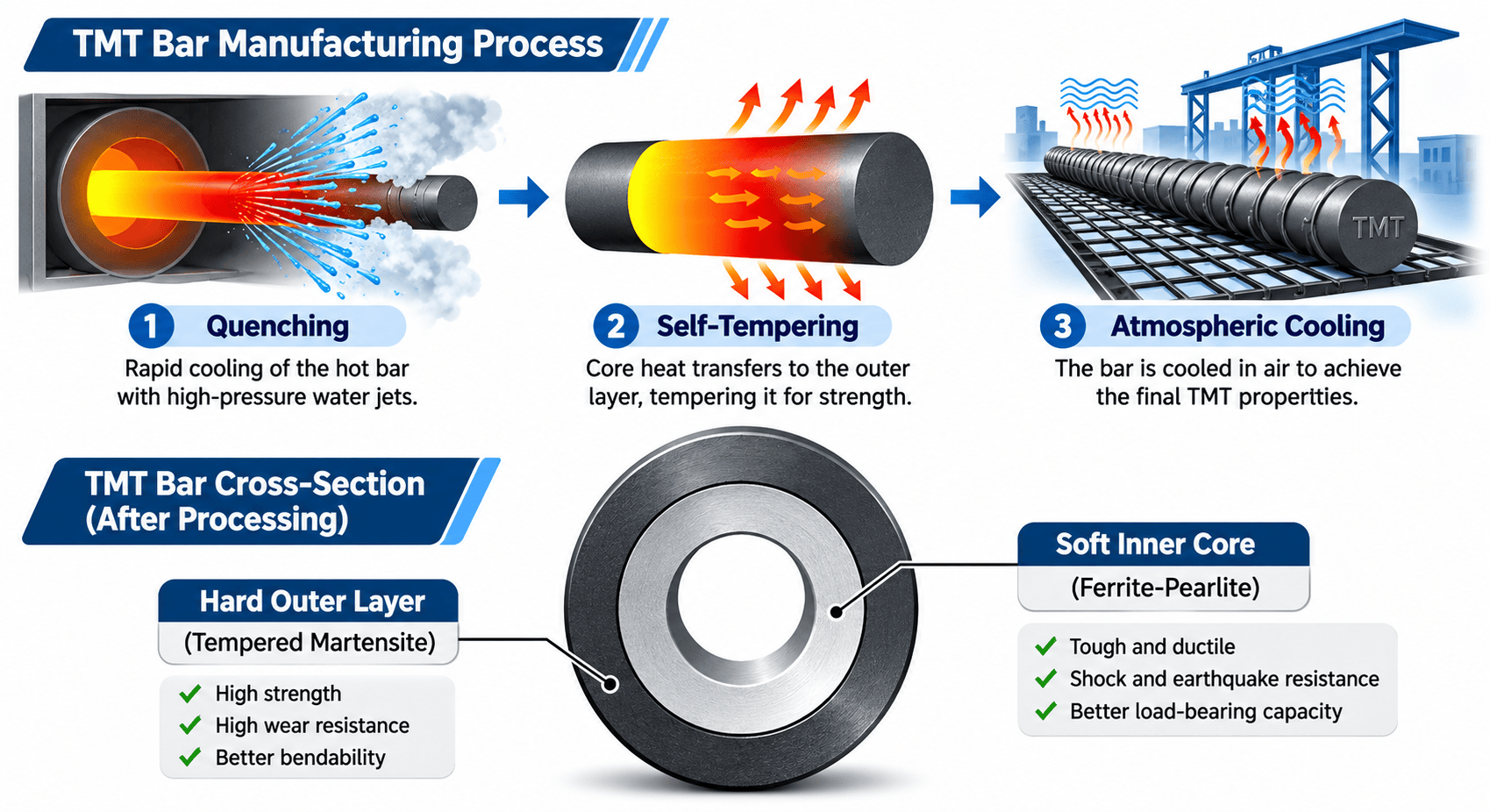
A scientific and engineering guide to choosing the right reinforcement steel for a safe, durable, and long-lasting home.
- When constructing a house, most people pay close attention to cement, bricks, sand, tiles, and finishing materials. However, one of the most important materials is often selected primarily on the basis of price: TMT reinforcement steel bars.
- TMT bars are not merely steel rods placed inside concrete. They form the tensile reinforcement system that helps concrete structures resist bending, tension, cracking and other structural forces.
- A house may look perfectly strong from the outside, but its long-term structural performance depends significantly on the quality of the materials hidden inside its columns, beams, slabs, and foundations.
- This raises an important question:
- If two TMT bars look almost identical, but one is manufactured to the required engineering specifications and the other is substandard, what happens to the house over the next 20, 30, or 50 years?
Let's understand the answer through material science, structural engineering, published research, and practical construction economics.
2. Understanding TMT Grades
Not every TMT bar has the same mechanical properties.
The Fe number represents the minimum characteristic yield strength expressed in megapascals (MPa) under the relevant Indian Standard.
For example, Fe 500 means a minimum characteristic yield strength of 500 MPa.
Here is a simplified comparison of commonly encountered grades.
| TMT grade | Minimum yield strength | Minimum elongation |
|---|---|---|
| Fe 415 | 415 MPa | 14.5% |
| Fe 415D | 415 MPa | 18% |
| Fe 500 | 500 MPa | 12% |
| Fe 500D | 500 MPa | 16% |
| Fe 550 | 550 MPa | 10% |
| Fe 550D | 550 MPa | 14.5% |
Reference: Mechanical property data presented by IIT Delhi's Virtual Labs based on IS 1786:2008. Always verify the applicable current standard and product certification.
What does the letter D mean?
The letter D indicates a ductility requirement.
Ductility is the ability of steel to undergo deformation before breaking.
This property is particularly important in earthquake-prone regions and structures subjected to dynamic loading.
For example:
Fe 500 provides a minimum yield strength of 500 MPa and 12% elongation.
Fe 500D provides the same minimum yield strength but 16% elongation.
Therefore, Fe 500D offers a higher specified elongation requirement than Fe 500.
Important: A higher grade number does not automatically make a bar the best choice for every house. The structural engineer must select the appropriate grade based on structural design, applicable codes, ductility requirements, and construction conditions. higher grade number does not automatically make a bar the best choice for every house. The structural engineer must select the appropriate grade based on structural design, applicable codes, ductility requirements, and construction conditions. higher grade number does not automatically make a bar the best choice for every house. The structural engineer must select the appropriate grade based on structural design, applicable codes, ductility requirements, and construction conditions. higher grade number does not automatically make a bar the best choice for every house. The structural engineer must select the appropriate grade based on structural design, applicable codes, ductility requirements, and construction conditions. higher grade number does not automatically make a bar the best choice for every house. The structural engineer must select the appropriate grade based on structural design, applicable codes, ductility requirements, and construction conditions. higher grade number does not automatically make a bar the best choice for every house. The structural engineer must select the appropriate grade based on structural design, applicable codes, ductility requirements, and construction conditions. higher grade number does not automatically make a bar the best choice for every house. The structural engineer must select the appropriate grade based on structural design, applicable codes, ductility requirements, and construction conditions. higher grade number does not automatically make a bar the best choice for every house. The structural engineer must select the appropriate grade based on structural design, applicable codes, ductility requirements, and construction conditions. higher grade number does not automatically make a bar the best choice for every house. The structural engineer must select the appropriate grade based on structural design, applicable codes, ductility requirements, and construction conditions. higher grade number does not automatically make a bar the best choice for every house. The structural engineer must select the appropriate grade based on structural design, applicable codes, ductility requirements, and construction conditions.
3. What Happens When Substandard TMT Bars Are Used?
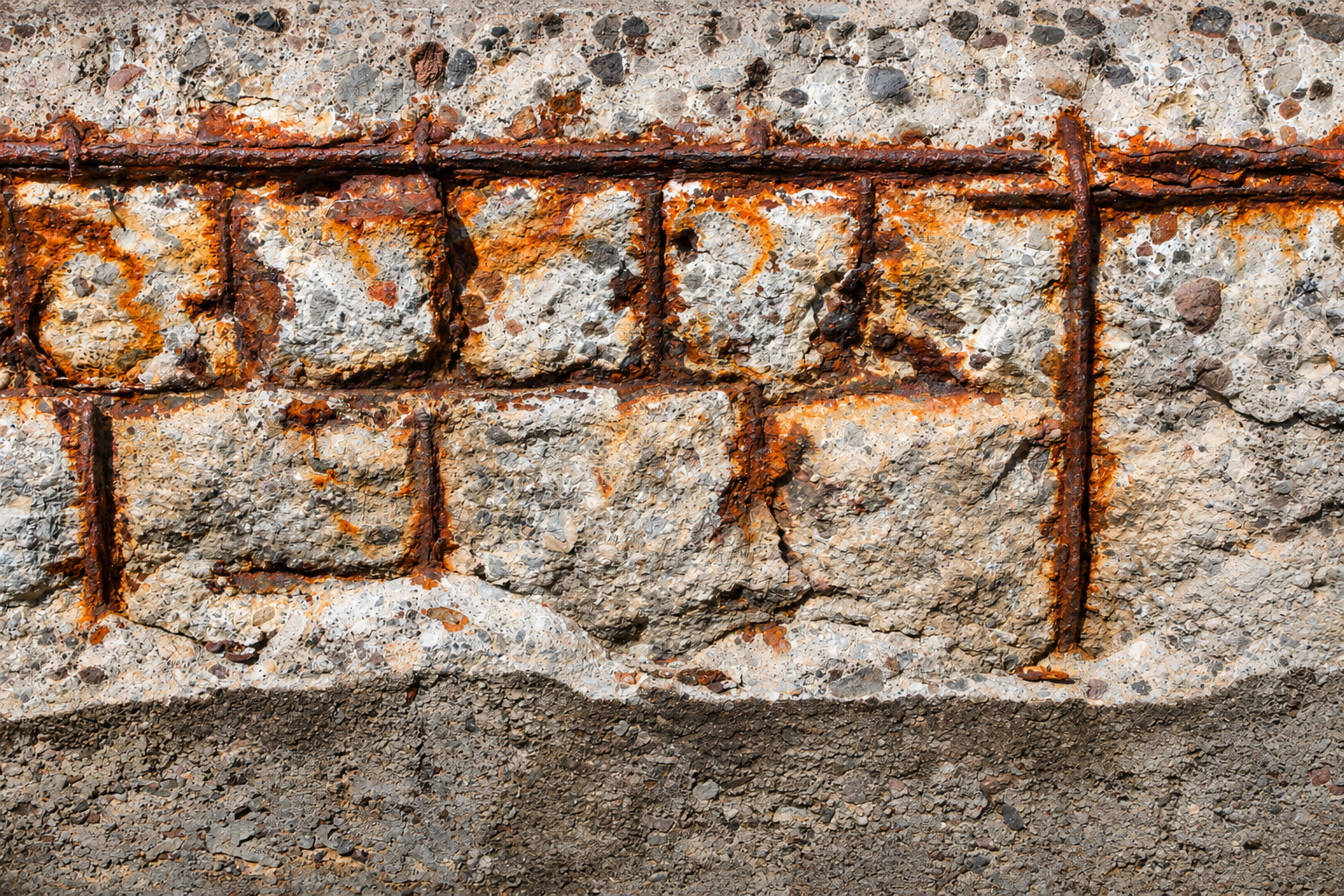
- This is where the difference between genuine quality steel and substandard reinforcement becomes extremely important.
- A bar may look normal, have visible ribs, and even carry an impressive-looking brand or grade marking. But appearance alone cannot establish its mechanical or metallurgical quality.
- Substandard reinforcement can have problems such as
- Inadequate yield strength.
- Lower-than-required elongation.
- Poor tensile strength.
- Inconsistent chemical composition.
- Improper heat treatment.
- Non-uniform internal microstructure.
- Incorrect mass per meter.
- Cracks during bending or rebending.
- Let's understand the possible structural consequences.
A. Reduced load-bearing reliability
- If a reinforcement bar does not achieve the specified yield strength, the structural member may not perform according to the assumptions used in its design.
- For example, a structural engineer designing with Fe 500 steel assumes that the reinforcement meets the relevant mechanical requirements.
- Using steel that does not meet those requirements introduces uncertainty into the structure.
- This does not mean every defective bar will immediately cause a building failure. It means the safety assumptions behind the structural design may no longer be reliable.
B. Poor ductility and sudden failure risk
- Ductility is particularly important during earthquakes and other extreme loading events.
- A properly designed ductile reinforced concrete structure can undergo controlled deformation and redistribute forces under certain loading conditions.
- Steel with inadequate ductility may fracture with less warning and reduce the structure's ability to undergo the deformation anticipated by its design.
- This is one reason why engineers pay attention to ductility grades, tensile properties and bend tests.
C. Cracks and corrosion-related deterioration
- Steel reinforcement is normally protected by the surrounding concrete.
- However, when reinforcement corrodes, the rust products occupy a greater volume than the original steel.
- This expansion generates pressure within the surrounding concrete.
- Over time, it can lead to:
- Internal tensile stresses.
- Cracks along reinforcement locations.
- Delamination of concrete cover.
- Concrete spalling.
- Loss of steel cross-sectional area.
- Deterioration of the steel-concrete bond.
- As the bond deteriorates, the ability of concrete and steel to act together is affected.
- Research published inMaterialsin 2022 reviewed 84 studies on corrosion and steel-concrete bond behaviour. It documented how corrosion can cause concrete cracking, delamination, spalling and deterioration of bond capacity.
- The important point is that reinforcement durability is not simply about how strong the steel is on the day it is purchased. Its behaviour within concrete over time also matters.
4. What Does IIT Madras Research Say About TMT Steel Quality?
- One particularly relevant scientific study was published in January 2023 in the international journal Construction and Building Materials.
- Research title: Mechanical characteristics of Quenched and Self-Tempered (QST or TMT) steel reinforcing bars used in concrete structures.
- Research team: Sooraj A. O. Nair, Prabha Mohandoss, Kiran Ram, Tayyab Adnan, and Radhakrishna G. Pillai.
- Institutional contribution: Indian Institute of Technology Madras (IIT Madras).
What did the researchers investigate?
- The researchers studied the microstructure and mechanical performance of TMT reinforcement bars obtained from different manufacturers.
- They examined the relationship between the internal metallurgical structure and the mechanical performance of reinforcement steel.
- A properly manufactured TMT bar should have a continuous, reasonably uniform, and concentric tempered-martensite outer ring surrounding a ductile ferrite-pearlite core.
- However, inadequate manufacturing control can produce a defective or non-uniform microstructure.
Important research findings
The study reported:
Up to 15% variability in stress-strain behavior and mechanical properties among rebars with inadequate cross-sectional phase distribution.
Poor-quality specimens showed cracks during bend testing.
Defective cross-sectional microstructure can influence both mechanical and corrosion-related properties.
The distribution of the outer hardened layer and inner ductile core is important to the overall performance of TMT reinforcement.
Why is this finding important for homeowners?
- Two bars may have identical nominal diameters and similar external appearances but different internal metallurgical structures.
- This means that visual inspection alone is not sufficient to establish reinforcement quality.
- Two bars may have identical nominal diameters and similar external appearances but different internal metallurgical structures.
- This means that visual inspection alone is not sufficient to establish reinforcement quality.
- Proper laboratory testing and manufacturing quality control are essential.
Scientific reference:
Nair et al. (2023),Mechanical characteristics of Quenched and Self-Tempered (QST or TMT) steel reinforcing bars used in concrete structures.
5. How Much Difference Does TMT Steel Quality Make in Price?
Many homeowners choose reinforcement steel based on the lowest available quotation.
But comparing only the price per kilogram can be misleading.
The correct comparison should consider:
Applicable grade and ductility class.
BIS certification and manufacturer.
Actual mass per meter.
Mechanical properties.
Manufacturing quality.
Test certificates.
Delivery and other commercial terms.
An illustrative price comparison
Suppose two suppliers offer reinforcement steel for a residential construction project.
| Particular | Steel A | Steel B |
|---|---|---|
| Quoted price per kg | ₹60 | ₹62 |
| Quantity required | 5,000 kg | 5,000 kg |
| Material cost | ₹300,000 | ₹310,000 |
| Price difference | ₹10,000 |
These are hypothetical prices for explaining the calculation, not current market quotations or actual brand prices.
In this example, the difference is ₹2 per kg, or ₹10,000 for five tonnes.
That ₹10,000 should not be viewed as the cost of buying a superior product unless both products have been tested and their specifications verified.
The correct principle is:
Do not pay a premium merely for a brand name. Pay for verifiable quality, compliance and reliable performance.
Similarly, do not compromise on specified mechanical properties simply to save a small amount during construction.
The hidden economic cost of poor-quality steel
The initial purchase price is only one component of construction economics.
Potential future expenses may include:
Structural inspections.
Crack investigation.
Corrosion treatment.
Concrete repair.
Reinforcement replacement or strengthening.
Waterproofing and protective treatments.
Structural rehabilitation.
These costs can be substantially more disruptive than the initial difference in material quotations.
There is no scientifically justified universal figure for how many additional years a particular premium TMT brand will add to a house. Service life depends on the complete structural design, materials, workmanship, exposure conditions and maintenance.
6. How Does TMT Quality Affect a House Over 20–50 Years?
A house is a long-term investment.
The steel placed inside the foundation, columns, beams,, and slabs is generally inaccessible after construction is completed.
Consequently, identifying defective reinforcement after the building is finished can be difficult and expensive.
Here are the major long-term considerations.
- First 0–5 years: Initial structural performance
- The reinforcement should perform according to the structural design.
- Poor mechanical properties can compromise the intended strength and deformation behaviour.
- However, visible cracks during this period can also result from shrinkage, inadequate curing, settlement, poor detailing or other construction defects. Not every crack indicates defective TMT steel.
- 5–15 years: Durability and environmental exposure
- Inadequate concrete cover, water penetration, carbonation, chlorides, and other environmental conditions can initiate or accelerate reinforcement corrosion.
- Defective steel microstructure or surface cracks may also affect corrosion behavior.
- 15–30 years: Progressive deterioration
- If corrosion progresses, the expansion of corrosion products may cause concrete cracking and loss of bond between reinforcement and concrete.
- This can affect structural stiffness, serviceability, and load-transfer mechanisms.
- 30–50 years: Long-term maintenance and structural reliability
- A properly designed, constructed, and maintained building can have a long service life.
- However, buildings exposed to moisture, poor drainage, aggressive environments, or inadequate maintenance may require significant repair much earlier.
- The important lesson is that the quality of reinforcement is one part of a complete durability system.
- Good TMT steel cannot compensate for poor concrete, inadequate cover, incorrect reinforcement placement or defective workmanship.
7. How Can a Homeowner Identify Genuine and Good-Quality TMT Bars?

Homeowners do not need to become metallurgical engineers, but they should know what to verify before purchasing steel.
1. Check the BIS Standard Mark.
For reinforcement bars covered by the applicable Indian Standard, check for the genuine BIS Standard Mark and valid manufacturer licence details.
The relevant product standard is IS 1786.
Do not rely only on a printed logo or a seller's verbal assurance.
Verify the license and manufacturer through the official BIS system.
Official website: https://www.bis.gov.in/
2. Verify the grade
Check whether the supplied steel is:
Fe 415
Fe 415D
Fe 500
Fe 500D
Fe 550
Fe 550D
The grade must match the structural engineer's specifications.
3. Ask for the manufacturer's test certificate.
Request the test certificate or material test report associated with the supplied batch.
Depending on the applicable standard, relevant parameters include:
Yield strength.
Tensile strength.
Percentage elongation.
Chemical composition.
Mass per metre.
Bend and rebend performance.
4. Check mass per meter.
A bar's nominal diameter alone does not establish that it has the correct mass.
For example, the theoretical nominal mass of a 12 mm steel bar is approximately 0.888 kg per meter.
The commonly used theoretical formula is:
Weight per metre = D² / 162
Where D is the nominal diameter in millimetres.
For a 12 mm bar:
12 × 12 / 162 = 0.889 kg/m approximately.
Actual acceptance should be determined using the tolerances in the applicable standard.
5. Do not rely on a simple bending demonstration.
- A bar that bends without visibly breaking is not automatically good-quality steel.
- Laboratory tensile, bend, and rebend tests are needed to establish compliance with the relevant specifications.
- Avoid heating or making unapproved bends in reinforcement at the construction site.
8. TMT Steel Is Only One Part of a Strong RCC Structure
An important engineering point is that a strong building is not created by using expensive steel alone.
The structural performance of an RCC building depends on several interacting components.
| Component | Engineering importance |
|---|---|
| TMT reinforcement | Tensile strength, ductility, and reinforcement performance |
| Cement | Binder responsible for the concrete matrix |
| Sand | Fine aggregate affecting workability and concrete properties |
| Stone aggregate | Provides the coarse aggregate skeleton |
| Water | Controls hydration and influences the water-cement ratio |
| Concrete cover | Protects reinforcement from environmental exposure |
| Curing | Supports cement hydration and concrete strength development |
| Structural design | Determines reinforcement size, quantity, spacing, and detailing |
| Workmanship | Ensures correct placement, compaction, and execution |
The importance of the water-cement ratio
The water-cement ratio is one of the important factors influencing concrete strength and permeability.he water-cement ratio is one of the important factors influencing concrete strength and permeability.he water-cement ratio is one of the important factors influencing concrete strength and permeability.
Excess water, if not accounted for in the mix design, can increase capillary porosity and allow harmful substances to penetrate the concrete more easily.
This can increase the risk of reinforcement corrosion under unfavorable exposure conditions.
The importance of concrete cover
Concrete cover is the thickness of concrete between the reinforcement and the external concrete surface.
It helps protect reinforcement from moisture, oxygen, and aggressive substances.
The required cover depends on structural element type, exposure conditions, fire requirements, and applicable design codes.
The importance of proper curing
Curing supports the hydration process and helps concrete develop its intended properties.
Inadequate curing can contribute to surface cracking, poor strength development, and increased permeability.
Therefore, even excellent TMT bars cannot guarantee a durable house if concrete quality and construction practices are poor.
9. What Should You Choose for Your Dream Home?
There is no universal answer that every homeowner should buy the highest-numbered grade or the most expensive steel available.
Instead, use the following decision-making principles:
- Follow the reinforcement grade specified by your structural engineer.
- Prefer steel from a reputable manufacturer with a verifiable BIS licence.
- Ask for batch-specific quality documentation.
- Check actual mass per metre and applicable tolerances.
- Verify tensile, elongation and bend performance where required.
- Do not mix different reinforcement grades or specifications without engineering approval.
- Store reinforcement above ground and protect it from prolonged exposure to moisture and contamination.
- Ensure correct reinforcement placement, concrete cover and curing.
- Have suspicious or undocumented steel independently tested before use.
For residential construction, the objective should not be to purchase the cheapest steel or automatically the most expensive steel.
The objective should be to purchase steel that reliably meets the structural design and applicable quality standards.
10. Conclusion: The Real Cost of Saving on Reinforcement Steel
- A house is often one of the largest financial investments a family makes.
- Paint, tiles, doors, and other finishing materials can be changed or upgraded over time. But reinforcement steel becomes embedded inside concrete and is difficult to inspect or replace.
- The difference between compliant and substandard reinforcement may not be visible on the day of purchase. Its consequences can become apparent through structural performance, durability, and maintenance requirements over time.
- Research by IIT Madras and other engineering institutions demonstrates why the internal metallurgical structure, mechanical properties and manufacturing consistency of reinforcement steel deserve serious attention.
- The right approach is to evaluate steel through engineering specifications, verified certification, and proper testing rather than price or appearance alone.
Build with engineering knowledge. Choose materials with evidence. Protect the investment that your family will depend on for generations.
Research Papers and Technical References
The following scientific and institutional resources informed this article:
IIT Madras – Nair et al. (2023): Mechanical characteristics of quenched and self-tempered (QST or TMT) steel reinforcing bars used in concrete structures. Construction and Building Materials .
https://doi.org/10.1016/j.conbuildmat.2022.129761https://doi.org/10.1016/j.conbuildmat.2022.129761IIT Delhi – Virtual Labs: Tensile testing of reinforcement steel and mechanical properties of different grades of reinforcement bars.
https://cs-iitd.vlabs.ac.in/exp/tensile-reinforcement/theory.htmlSyll and Kanakubo (2022): Impact of Corrosion on the Bond Strength between Concrete and Rebar: A Systematic Review. Materials , 15(19), 7016.
https://doi.org/10.3390/ma15197016https://doi.org/10.3390/ma15197016Nair and Pillai (2017): TM-Ring Test—A quality control test for TMT (or QST) steel reinforcing bars used in reinforced concrete systems. The Indian Concrete Journal ..
Bureau of Indian Standards: IS 1786 – High Strength Deformed Steel Bars and Wires for Concrete Reinforcement.
https://www.bis.gov.in/https://www.bis.gov.in/
Editorial note: This article is intended for general educational purposes. It does not replace structural design, material testing, or professional engineering advice. Actual steel selection and reinforcement detailing must be approved by a qualified structural engineer. article is intended for general educational purposes. It does not replace structural design, material testing, or professional engineering advice. Actual steel selection and reinforcement detailing must be approved by a qualified structural engineer.
